
What Size Trailer Should I Rent? A Fox Valley Guide to Picking the Right One
"Which trailer do I need?" is the question we get more than any other. Fair enough. Rent too small and you're making three trips. Rent too big and you're paying for trailer you don't need, and maybe towing more than your truck should.
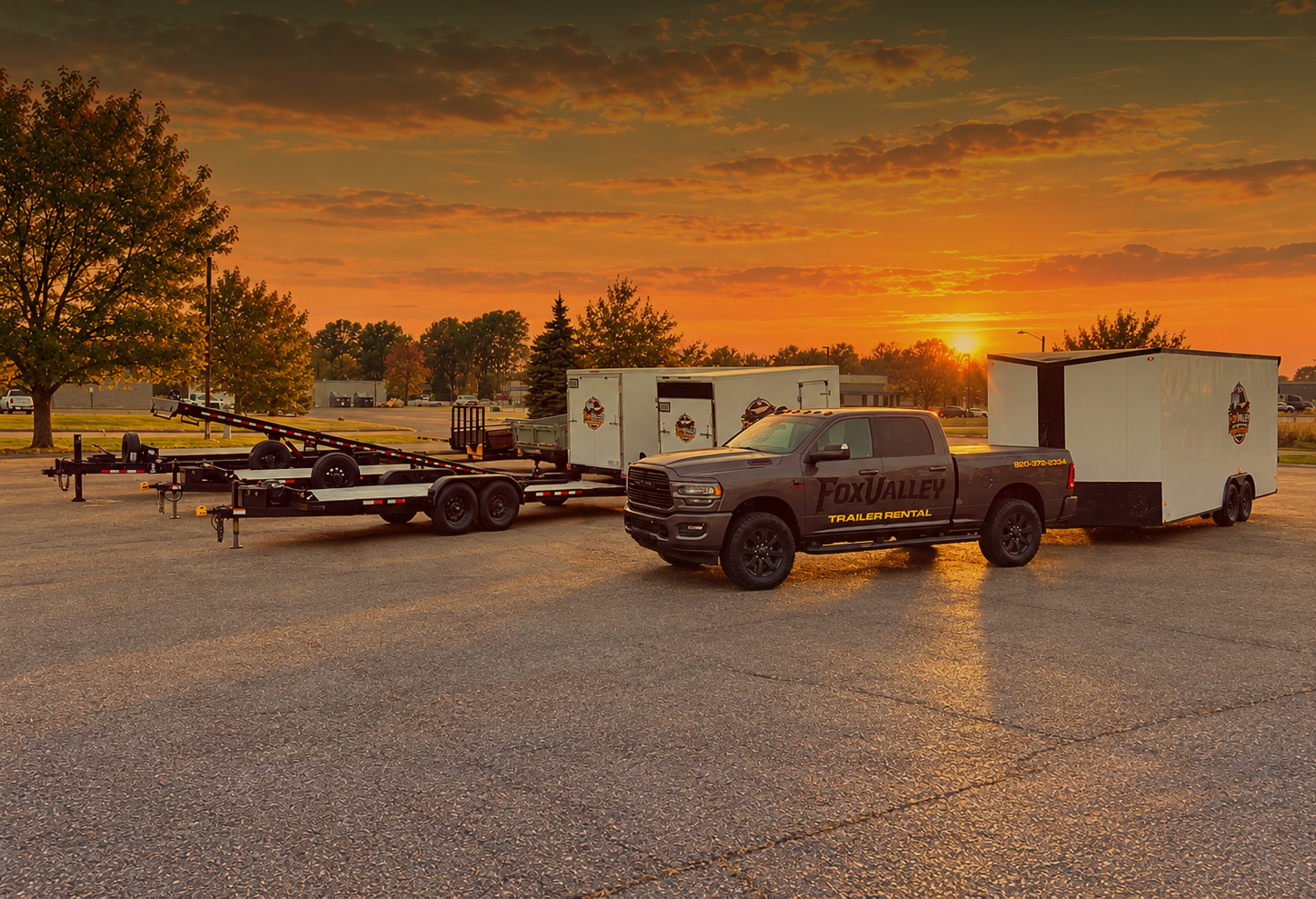
Here's how we help people pick, in the same order we'd walk you through it on the phone: what you're hauling, what you're towing with, and how to load it. Every trailer spec below comes straight from the trailers sitting on our lot in Kimberly.
The 30-second answer
| If you're... | Start with | Hitch ball |
|---|---|---|
| Moving out of an apartment or storage unit | 6x12' enclosed | 2" |
| Moving a bigger apartment or a small house | 7x16' enclosed | 2-5/16" |
| Moving a whole house, or a vehicle that has to stay dry | 8.5x20' enclosed w/ winch | 2-5/16" |
| Hauling mulch, brush or a garage cleanout | 6x12' dump (10K) | 2-5/16" |
| Hauling rock, dirt, concrete or demo debris | 7x14' dump (14K) | 2-5/16" |
| Bringing home a car or small truck | 20' car hauler w/ winch | 2-5/16" |
| Hauling a full-size pickup or something heavier | 20' HD car hauler w/ winch | 2-5/16" |
| Moving equipment, pallets or wide loads | 8.5x20' deckover or 8.5x24' tilt deckover | 2-5/16" |
| Grabbing a mower, ATV or a few pieces of furniture | 5x8', 12' or 14' aluminum utility | 2" |
| Heading up north with sleds | 2-place snowmobile trailer | 2" |
Want the reasoning behind those picks? Keep reading.
Step 1: Match the trailer to the job
Moving furniture and boxes
For moves, go enclosed. Your couch stays dry, nothing blows out on the highway, and you don't have to strap down every single box. All three of our enclosed trailers come with E-track, adjustable straps, tie-down clips and three moving blankets, so you don't need to buy or borrow anything.
- 6x12' enclosed is right for a studio, a one-bedroom apartment or emptying a storage unit. It's 7 feet tall inside, so a fridge or a mattress stands up, and it carries up to 1,690 lbs. It's light at about 1,300 lbs empty and takes a 2" ball, so plenty of SUVs and half-ton pickups can pull it. Check your owner's manual to be sure.
- 7x16' enclosed is the all-around size: a bigger apartment, a small house, or a UTV or motorcycle. It carries up to 4,485 lbs and has brakes on both axles, so it tows steady when it's full.
- 8.5x20' enclosed w/ winch is for whole-house moves and anything valuable that has to stay covered, including vehicles. It's 7.5 feet tall, carries up to 6,650 lbs, and has a 9,500 lb winch with a remote plus a backup camera. Bring a truck for this one.
Tip: If you're stuck between two sizes, go up one. Making a second trip across the Fox Cities costs more in time and gas than the bigger trailer does.
Yard work, landscaping and cleanouts
If the load is loose material like mulch, rock, dirt, shingles or demo debris, you want a dump trailer. Shoveling a load off a flatbed is a long afternoon. A dump trailer unloads it in about a minute.
- 6x12' dump trailer (10K) carries up to 6,910 lbs and is the one we point half-ton truck owners to. It comes with a tarp, ramps, wheel chocks and a safety vest, and the rear gate swings open like doors or works as a spreader.
- 7x14' dump trailer (14K) carries over 9,000 lbs, and we have two of them (here's the other). It's built for big landscaping jobs, concrete and construction debris, and it can even haul a skid steer or a compact tractor. A 3/4-ton truck is recommended.
Watch the weight, not the size. A dump trailer full of stone weighs far more than one full of mulch. Rough numbers:
- Mulch: roughly 400 to 800 lbs per cubic yard
- Topsoil: roughly 2,000 lbs or more per cubic yard, and more when it's wet
- Gravel and landscape stone: roughly 2,500 to 3,000 lbs per cubic yard
That means a couple yards of stone can max out a smaller trailer long before it looks full. When you order from the landscape yard, ask them what the load weighs. They'll know.
Cars, trucks and project vehicles
Both of our 20' car haulers have a 2' dovetail, 5' slide-out ramps, stabilizer jacks, vehicle tie-down straps and a 9,500 lb winch with a wireless remote. That means a car that doesn't run still loads easily. The difference between them is how much they can carry:
- 20' car hauler carries up to 7,200 lbs. That covers most cars, small SUVs and mid-size pickups.
- 20' HD car hauler carries up to 9,200 lbs on heavier 6K axles. Pick this one for full-size pickups, big SUVs, or a vehicle with a load in it.
Not sure what your vehicle weighs? Look at the sticker on the driver's door jamb or search the year, make and model. Most cars run roughly 3,000 to 4,000 lbs, and full-size pickups often run 4,500 to 6,000 lbs.
Equipment, pallets and wide loads
- 8.5x20' deckover is a full 102" wide with no fenders in the way, so a forklift can load pallets from the side. It carries up to 6,755 lbs, has 8' slide-out ramps, and works with a half-ton truck.
- 8.5x24' tilt deckovers (we have a Ironbull and a Big Tex) carry around 9,000 lbs. The whole deck tilts hydraulically, so there are no ramps to set up, and a 12,000 lb winch pulls the load on. These are the go-to for skid steers and other compact equipment, wide vehicles and oversized loads. A 3/4-ton truck is recommended.
Small hauls and toys
- 5x8' utility is light and easy to tow. Good for a mower, an appliance or a dump run.
- 12' utility has 21" wood sides and a full-size ramp gate, and straps are included. Great for brush, firewood, furniture and ATVs.
- 14' aluminum utility is the lightest of the bunch at about 900 lbs empty, with a fold-down rear ramp plus side-load ramps. It's built for side-by-sides and UTVs.
- 2-place snowmobile trailer has a tilt bed, a front shield against slush and rocks, and two ski tie-down bars. It also works for 4-wheelers, small UTVs and even hot tubs.
Camping
Our 21', 22' and 27' travel trailers are newer bunkhouse campers with full kitchens, bathrooms with a shower, heat and air conditioning, and power awnings. They sleep anywhere from 5 to 10 people depending on size. Campers have a 2-night minimum and are reserved by request, so reach out early for summer weekends.
Step 2: Make sure your vehicle can pull it
This is the step people skip, and it's the one that matters most. Before you book, check these four things.
- Towing capacity. It's in your owner's manual. The number has to cover the trailer and everything on it, not just the load. Example: the 6x12' dump trailer weighs about 3,080 lbs empty, so a full load puts you near 10,000 lbs.
- Hitch ball size. Our 5x8', 12' and 14' utility trailers, the 6x12' enclosed and the snowmobile trailer take a 2" ball. Everything else takes a 2-5/16" ball. Don't have the right one? Add a ball hitch at checkout.
- Light plug. Our bigger trailers use a round 7-pin plug. If your vehicle only has a flat 4-pin, call or text us before you book.
- Brake controller. Our heavier trailers have electric brakes, and those only work if your vehicle has a brake controller. A lot of trucks have one built into the dash. If yours doesn't, add our Bluetooth brake controller at checkout.
The quick version: half-ton trucks are a good match for our 6x12' dump trailer and 8.5x20' deckover, as long as your truck's rating covers the loaded weight. The 14K trailers (7x14' dumps and 8.5x24' tilt deckovers) call for a 3/4-ton truck. Our tow guide goes into more detail.
Step 3: Load it right
- Heavy stuff up front. Put about 60% of the weight in the front half of the trailer, ahead of the axles. Too much weight in the back makes a trailer sway, and sway is how people end up in the ditch on 41.
- Center it side to side. Keep the weight even across the trailer.
- Strap it at four points. Use the D-rings and E-track. Anything that can slide eventually will.
- Re-check after a few miles. Straps settle. Pull over somewhere safe and snug them back up.
- Test the lights before you leave the lot. Brake lights, turn signals, both sides.
- Stay under the payload. Every trailer's max load is on its page on our site. Going over it is hard on tires, bearings and brakes, and on your truck too.
What comes with every rental
This is what we're known for. You shouldn't have to make a hardware store run before you can use the trailer you just paid for. Depending on the trailer, that means:
- Ratchet and tie-down straps, E-track and moving blankets on the enclosed trailers
- A winch with a remote and vehicle straps on the car haulers
- A tarp, wheel chocks and a safety vest on the dump trailers
- A spare tire, bottle jack and lug wrench
- Free unlimited miles anywhere in the U.S.
- 24/7 self-service pickup and drop-off with a lockbox. We text you the steps before your rental starts.
If you'd like a walkthrough the first time, we'll meet you in person by appointment on weekdays between 8 AM and 5 PM.
Still not sure?
Call or text us at 920-372-2334 and tell us what you're hauling and what you're towing with. We'll tell you straight up which trailer fits, even if it's the smaller, cheaper one.
Ready to go? See every trailer and check availability. Booking takes about a minute, and pickup is 24/7.